

The three costs of a robot on your desk
Every robot here has three prices, and only one of them is printed on the box. Money is the easy one to compare. Attention is the one you pay every day. Privacy is the one you only think about afterwards. None of these products is simply "expensive" or "cheap" — each is a particular mix of all three, and the mix is the thing worth shopping for.
The cost in money
Sticker price is the wrong number whenever a subscription is involved. Here is hardware plus 36 months, using annual billing where a discount exists — the charitable reading for anything with a recurring fee.
| Device | Hardware | Subscription | 3-year total | Own it after? |
|---|---|---|---|---|
| Vector 2.0 (annual billing) | $199.99 | $99.99/yr | $499.96 | Keeps the shell, loses voice + ChatGPT |
| Vector 2.0 (Claude backend) | $199.99 | $139.99/yr | $619.96 | Keeps the shell, loses voice + ChatGPT |
| Vector 2.0 (monthly billing) | $199.99 | $11.99/mo | $631.63 | Keeps the shell, loses voice + ChatGPT |
| Loona | $499 | None | $499 | ✓ fully |
| EMO Go Home | $369 | None | $369 | ✓ fully |
| EMO | $279 | None | $279 | ✓ fully |
| AIBI | $199 | None | $199 | ✓ fully |
| Eilik | $169.99 | None | $169.99 | ✓ fully |
| Pixl Nub (VIP) | $200 all-in | None | $200 | ✓ forever — shipping & tax included |
Where the money crosses over
Eilik sits at the bottom of the three-year table and, unusually, stays there. It is $169.99 once, with no subscription, no app, and no accessory required to make it work. Nothing else in this comparison is cheaper to own.
The one crossover to watch is Vector. It starts $30 below Eilik and ends up nearly triple it over three years — around $500, because the AI subscription never stops. If the appeal of Eilik was value, Vector is the opposite of it in slow motion.
And there is a cost the table cannot capture. Eilik is the calmest robot here and the closest to earning its place beside your work. Even so, it has no idea what you did today — and a robot that cannot see your hours cannot help you protect them.
The cost in attention
This is the cost no receipt shows and no table can total. Every product on this page is built to react; none is built to report. Look at what they measure — proximity, touch, voice, faces, mood, tricks learned — and notice that not one of those is a fact about your work.
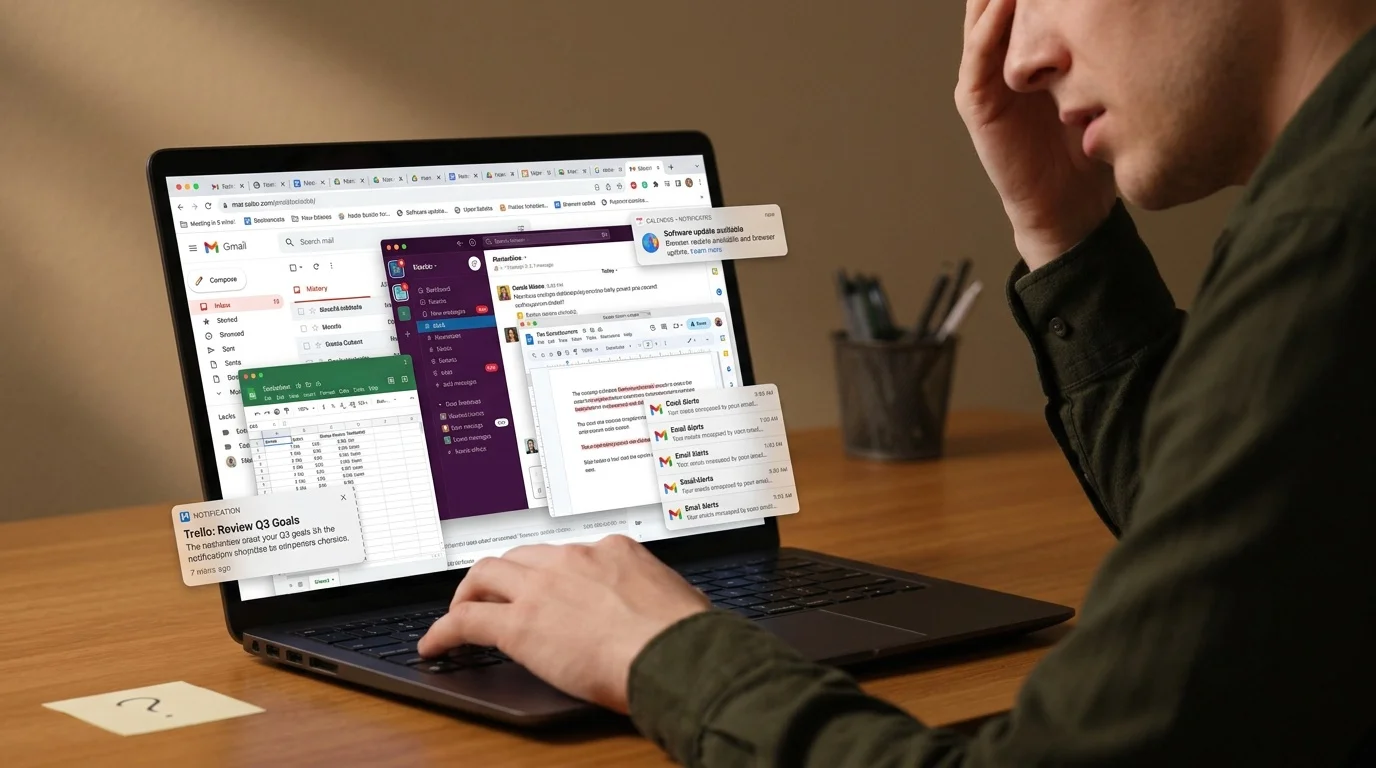
So the trade is not really robot versus robot. It is attention. A desk robot that walks, talks and plays is taking small pieces of the same 24 hours everyone gets: charming pieces, but pieces you do not get back. None of them can tell you how long you held a focus session, how many times you were interrupted, or how long it took you to get back on task. The nearest anyone comes is software — RescueTime and Rize watch your screen, not your attention, and Timeular records what you told it you were doing. None of them is in the room with you.
Eilik is the cheapest robot here in attention as well as dollars. It stays where you put it, never speaks, and never calls you across the room — so of everything on this page it is the least likely to steal a minute of your afternoon. It is still an object you will pick up and fiddle with, just on your terms rather than its.
The cost in privacy
The third price is the hardest to see and the hardest to undo. Almost every companion robot here carries a camera and a microphone, because that is what makes it feel alive — it recognises faces, follows gestures, answers to its name. What it sees and hears either stays on the device or travels to a company cloud, and only some products make that choice explicit. A device that lives where you work and take calls is a sensor in the room, whatever else it is.
Nothing. Eilik runs entirely on-device with no app, no account and no cloud, so there is no camera feed or voice recording travelling anywhere. For anyone who wants a companion without a device watching the room, it is the cleanest option in the category.
Eilik shows the category can be built privately. Pixl Nub takes the same instinct and adds the one thing Eilik leaves out: it measures focus session length, interruption count and refocus time with 60 GHz radar — presence, movement and breathing, no faces or words, no camera, nothing sent to a cloud.
Make the most of the 24 hours you get
Two people sit down at the same desk with the same 24 hours. One lets the day happen to them; the other treats their attention as the scarcest thing they own and quietly gets 1% better at spending it. Multiply that by a year and the two are not in the same place.
That second person is who this page is written for. The robots below are genuinely lovely, and there is no judgment in wanting one — they are built to be played with. But they compete for the same hours you are trying to make something of. If you want a friendly thing on your desk and want to compound a little every day, keep reading.
Eilik is the value pick in this category and the least demanding. At $169.99 it is roughly a third of an EMO, it runs offline with no app to crash, it has no subscription, and it lasts four to five times longer per charge. It is also the quietest robot here — it does not walk, talk or call your name across the room, so it takes far less of your attention than the others. Which makes it the easiest of the four to defend, and still not the same as a robot that helps you protect the day.

Why people look past Eilik
Eilik is the one product in this category that is hard to argue with. It is cheap, it is durable, it runs entirely offline, and it asks nothing of you after purchase. The reason people still search for an alternative is that it is also the least capable: it does not talk, it does not recognize you, and it does not move.
Which, if you are trying to protect your attention, is quietly its best feature. Of everything on this page Eilik is the robot least likely to steal a minute of your afternoon — that is a stronger recommendation than it gets credit for.
So the alternatives fall into two groups. Some are more robot for more money — EMO and Vector. Others are a different product entirely — Loona if you want a pet, Pixl Nub if what you actually wanted was a desk robot that could tell you where your working day went.
Eilik at a glance
| Price | $169.99 (list $189.99) |
|---|---|
| Subscription | None |
| Battery | ~8–10 hours |
| Mobility | Stays put |
| App required | No — fully offline |
| Conversation | No |
| Respects your time | Mostly — too quiet to distract you |
The alternatives, in order
EMO — $279, the upgrade if you want it to talk
EMO is what most people are picturing when they imagine a desk robot: it walks, it talks, it recognizes your face, and its ChatGPT mode carries no extra fee. The Go Home version at $369 adds a dock it navigates back to on its own, which matters because EMO's battery only lasts about two hours.
What you give up: roughly $110 more than Eilik, most of the battery life (hours instead of most of a workday), the app-free simplicity — and the calm. EMO is built to be noticed; Eilik is built to be ignored.
AIBI — around $199, the middle ground
AIBI is a pocket-sized companion that can live on a desk or come with you. It has no subscription and sits between Eilik and EMO on both price and capability.
What you give up: Eilik's battery life and its absolute simplicity. AIBI is more product with more to maintain.
Vector 2.0 — $199.99, and the only one that bills you again
If you are shopping from Eilik, Vector's $199.99 sticker is the closest to what you already expected to pay. It is also the only product here that charges for its personality: $11.99/month or $99.99/year, or the voice and ChatGPT features stop responding.
What you give up: the thing you liked most about Eilik — that nothing about it can be switched off from a server.
Loona — $499, for a different job
Loona is a robot dog that roams the room. It has no subscription, and it is a genuinely different purchase rather than a bigger Eilik.
What you give up: the desk form factor and a large multiple of the price.
The honest part
Eilik gets the closest of anything here to the thing that matters, and it deserves saying: it proves a desk robot can be charming and still stay out of your way. Pixl Nub takes that same idea and adds the one capability Eilik leaves on the table — it can actually see your day.
Nub is a desk robot with a face of its own that measures focus session length, interruption count, refocus time, and contactless heart rate and breathing from across the desk, via 60 GHz radar. No camera, nothing to wear, nothing to charge.
It belongs on this page for the reader who wanted a calm desk companion and then realised the calm was the setup, not the point — the person who gets the same 24 hours as everyone else and wants to compound 1% a day on top of it. That is who Nub is for.
The full comparison matrix
| Device | Price | Subscription | 3-yr total | Moves? | Battery | Attention cost | Privacy | Measures focus? | Yours if cancelled? |
|---|---|---|---|---|---|---|---|---|---|
| EMO | $279 | None | $279 | Walks on the desk | ~2h | High — walks, talks, reacts | Camera + mic always on | ✗ | ✓ fully |
| EMO Go Home | $369 | None | $369 | Walks + self-docks | ~2h | High — walks, talks, reacts | Camera + mic always on | ✗ | ✓ fully |
| Vector 2.0 | $199.99 | $11.99/mo · $99.99/yr | $499.96 | Roams the desk | ~1–2h active | Highest — roams + answers | Camera + mic → cloud | ✗ | ✓ device; voice + AI stop |
| Eilik | $169.99 | None | $169.99 | Stays put | ~8–10h | Low — silent, stays put | None — fully offline | ✗ | ✓ fully |
| Loona | $499 | None | $499 | Roams the room | ~2–4h | High — follows & plays | Camera + mic | ✗ | ✓ fully |
| Jibo | Used only | None (service dead) | — | Stays put | Mains | Medium — dead hardware | Camera + mic (offline) | ✗ | ✓ brick |
| Cozmo | Used only | None | — | Roams the desk | ~1h | Medium — plays with cube | Camera (app abandoned) | ✗ | ✓ app abandoned |
| AIBI | $199 | None | $199 | Pocket / desk | ~5h | Medium — chatty | Camera + mic | ✗ | ✓ fully |
| Pixl Nub (VIP) | $200 | None | $200 | Not worn, not mobile | Mains | Lowest — one quiet look | 60 GHz radar, no camera | ✓ the whole point | ✓ forever |
Prices sourced from vendor websites as of October 2026. Shipping, tax and accessory costs excluded except on the Pixl Nub VIP row, whose $200 is all-in.
Which one is right for you
- You want value, durability, and a robot that stays out of the way → stay with Eilik. Nothing here beats $169.99 with no app and no subscription.
- You want it to talk and walk → EMO at $279, or $369 Go Home if you want it to dock itself.
- You want something you can carry between desks → AIBI around $199.
- You want a robot pet that moves around the room → Loona at $499.
- You want a calm desk robot that also tells you where your hours go → that is what we built Nub for, $200 all-in with no subscription.
FAQ
What is the best alternative to Eilik?
If you want a talking, walking robot instead, EMO ($279, no subscription) is the upgrade. If you want the same offline, app-free simplicity in a different shape, AIBI ($199) is the closest match. If you want a robot that actually reports on your working day rather than reacting to it, Pixl Nub ($200 all-in, no subscription) is the different category entirely.
Is Eilik better than EMO?
They optimise for different things. Eilik wins on price ($169.99 vs $279), battery life (roughly four to five times longer), simplicity — fully offline, no app — and calm: it is the robot least likely to interrupt you. EMO wins on capability: it talks, walks, recognizes faces and has ChatGPT. Buy Eilik if you want charm and durability at a low cost; buy EMO if you want a robot with a personality that interacts with you.
Does Eilik need a subscription or an app?
Neither. Eilik is one of the few desk companions that runs entirely on-device. There is no app to install, no account to create, no cloud dependency and no recurring fee. That makes it unusually durable — nothing about it can be switched off from a server.
Is Eilik a good desk companion?
It is the best value one, and the calmest. It is expressive, it reacts to being handled, it lasts most of a working day per charge, and it costs $169.99 once. It will not nag for your attention the way a walking, talking robot does. It is not a productivity tool and it never claims to be.
Do any desk companion robots track focus?
None of them. EMO, Eilik, Vector, Loona and AIBI are all reaction and personality products; they have no concept of a focus session, an interruption or a refocus time. The only crossovers are software like RescueTime, which measures your screen rather than your attention, and desk sensors like Pixl Nub, which measure focus, interruptions and contactless heart rate from across the desk.
What is the cheapest desk robot with no subscription?
Eilik at $169.99 is the cheapest credible desk companion with no subscription and no app. The next step up is AIBI around $199 and EMO at $279; both are also subscription-free. Vector 2.0 has a lower sticker price at $199.99 but adds $99.99/year for its AI features.
Is a desk robot like Eilik a distraction?
Less than the others. Eilik stays put, does not talk and never calls you over, so it takes far less attention than EMO, Vector or Loona. But it is still a desk object that asks to be picked up — and, like every robot here, it cannot measure the interruptions you actually care about.